
HGV fleet compliance without the spreadsheet
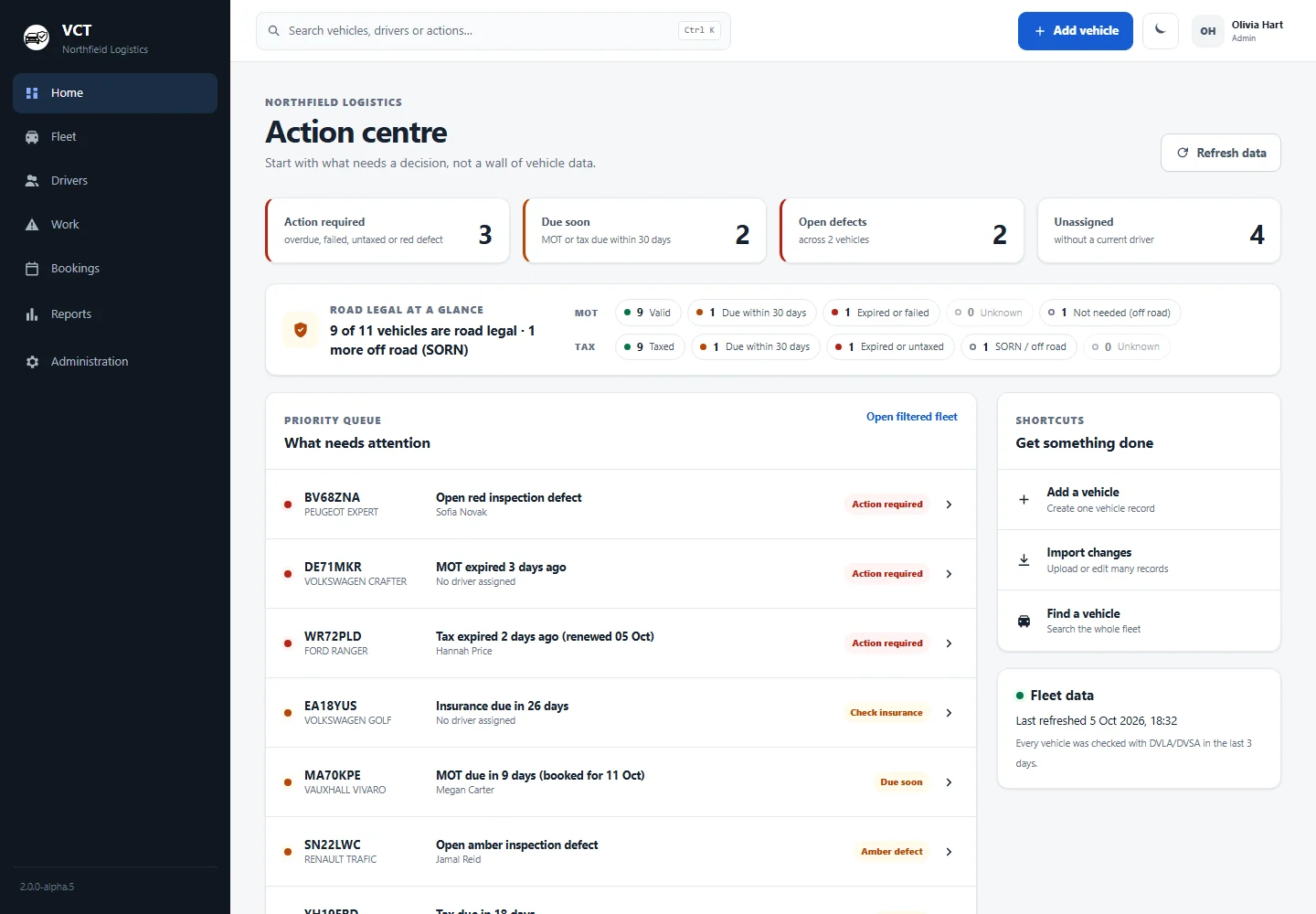
VCT checks every truck's annual test with DVSA and its road tax with DVLA every night. Drivers do their walkaround check on their phone, and every defect stays on the list until a later check shows it's fixed.
Truck annual tests and road tax, checked every night
DVSA's MOT history service covers HGVs, buses, coaches and trailers as well as cars and vans. VCT reads each truck's annual test results from it the same way it reads a van's MOT.
- Annual test expiry date, result, defects and mileage for every truck
- Road tax status and due date from DVLA. The HGV Road User Levy is paid with road tax, so a truck shown as taxed has its levy covered
- Anything due in the next 30 days shows as Due soon, with reminder emails and a weekly round-up
- Recheck one truck or the whole fleet at any time, for example straight after a test
How HGV annual tests differ from van MOTs
Gov.uk's page on the annual test for HGVs, buses and trailers sets out the timing. A new truck's first annual test is due 12 months after it was first registered, and HGVs usually need testing every year after that. A van's first MOT comes at three years, so a mixed fleet runs on two different clocks.
VCT keeps both in one list. You don't need to remember which vehicles follow which rule, because the expiry date comes straight from DVSA.
The levy works differently from the test. Gov.uk's HGV Road User Levy collection explains that it applies to HGVs of 12,000kg or more, and that UK-registered trucks pay it in the same transaction as their vehicle tax. That's why VCT's road tax check covers it.
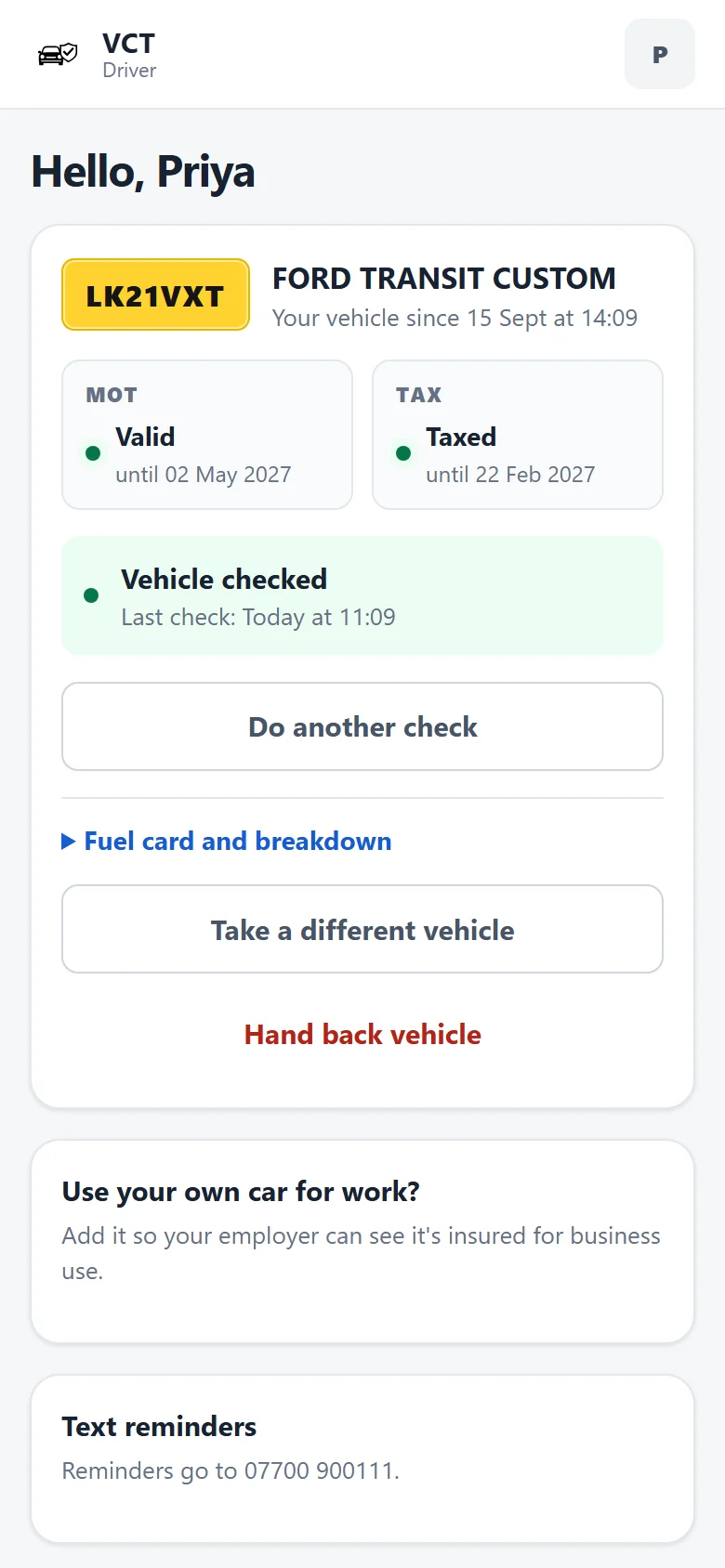
An HGV walkaround check app on the driver's phone
DVSA's guidance on daily HGV walkaround checks puts the check on the driver before each journey. Defects should be reported in writing to whoever deals with them, and a record of each check kept, because DVSA can ask to see it at a roadside check.
VCT turns that into a few taps. The checklist is yours to edit, so you can add HGV items to match DVSA's guidance. More detail on the walkaround check app page and in our HGV walkaround check guide.
- Runs in the phone's browser, with nothing to install
- Each item marked green, amber or red, with a note for anything that isn't green
- Every check is kept, so you can show when it was done and by whom
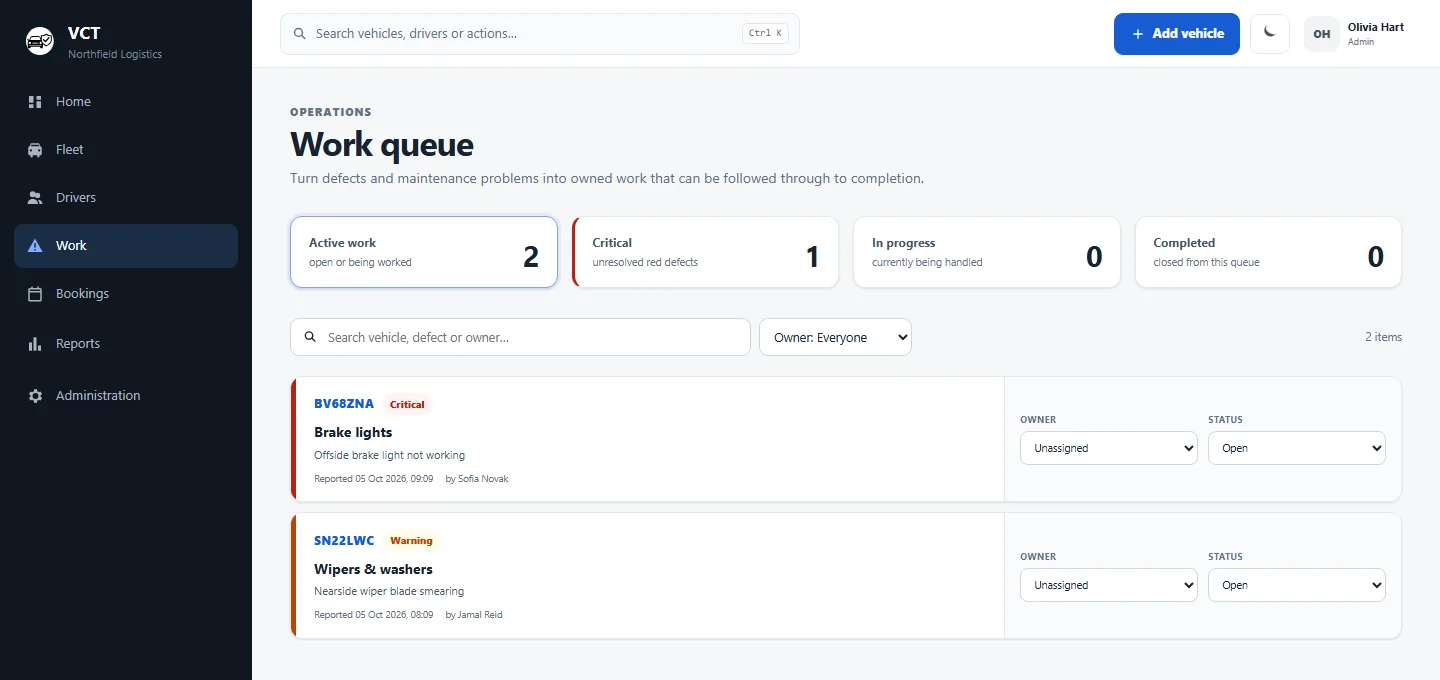
From a defect on the walkaround to a fixed truck
- The driver reports it. Anything marked red or amber goes straight to the office with the driver's note.
- It lands in the work queue. Every defect becomes work with an owner. Critical items stay at the top.
- Someone fixes it. The owner tracks the job through to done.
- A later check closes it. The defect only clears when a check on that truck marks the same item green, so nothing drops off the list on someone's word.
Records ready for an audit or a DVSA visit
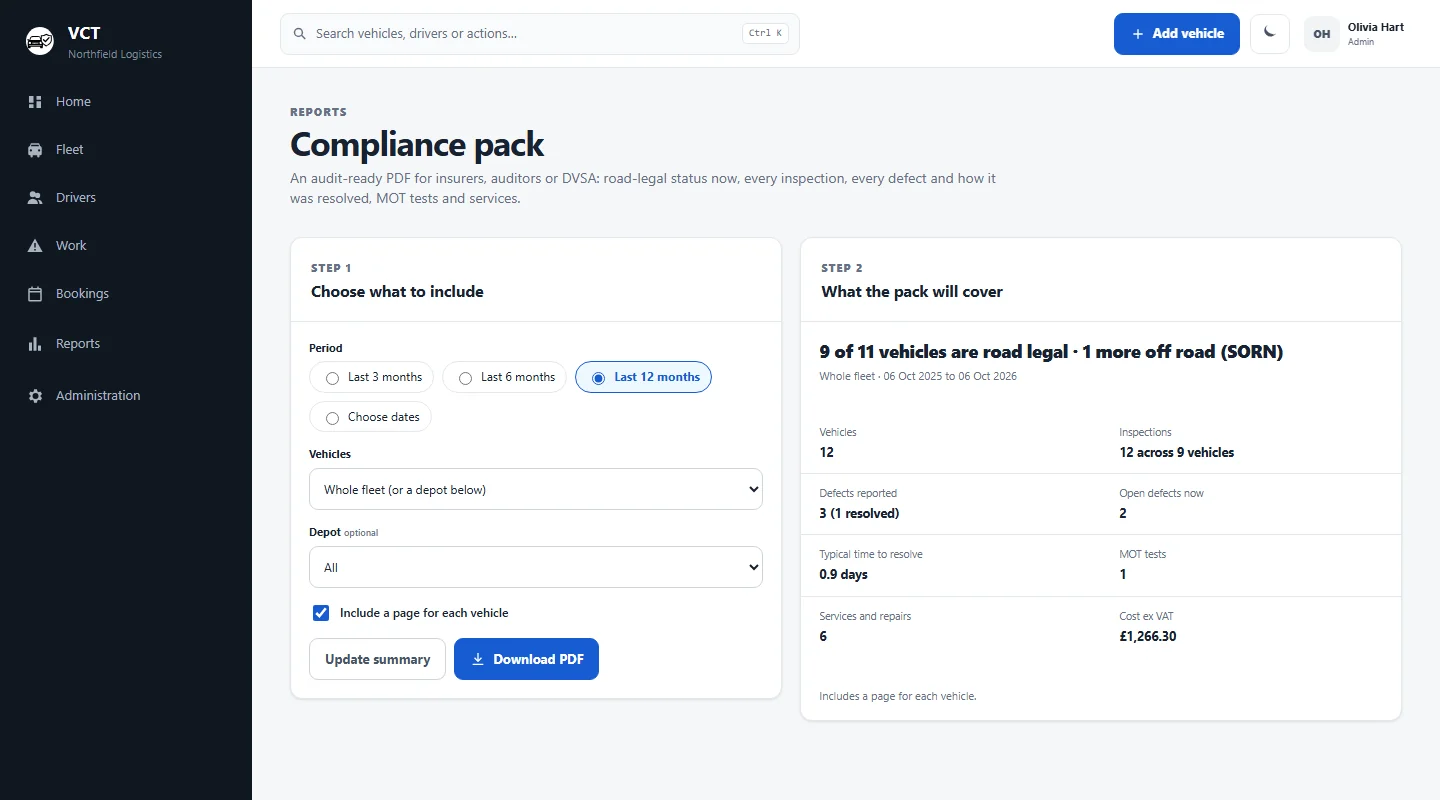
DVSA's guide to maintaining roadworthiness says driver defect reports and safety inspection records must be kept for at least 15 months, and that electronic records are acceptable. VCT keeps every walkaround check and defect, and the compliance pack pulls them together for the period and depot you choose.
- Road-legal status for every vehicle
- Every walkaround check and every defect, with how fast it was fixed
- MOT and annual test results, services and costs
- One PDF for an O-licence audit, a DVSA visit or an insurer's renewal
Trucks and vans in one place
Most operators run more than trucks. VCT puts HGVs, vans, cars and staff cars used for work on one fleet list, with one Action centre that tells you how many vehicles are road legal and what needs doing first. Van MOTs and road tax work the same way as for trucks; see fleet MOT and tax reminders.
- No PMI or safety inspection scheduling
- No operator licence management. VCT helps you keep records an operator needs, but it doesn't manage the O-licence itself
- No tachograph analysis
- No Driver CPC tracking
- Trailers can't be checked automatically, because they have no registration number
- DVSA's heavy-vehicle test history starts in 2018, so older tests won't show
- A new HGV's first annual test is due 12 months after registration, much sooner than a van's first MOT at three years, so it's worth checking new trucks as soon as they join the fleet
If you need those, VCT can sit alongside your maintenance provider's system or your tachograph software. It doesn't claim to replace them, and it isn't approved or accredited by DVSA.
The same price for a truck as a van
£3.50 per vehicle a month, falling to £2.50 per vehicle for bigger fleets (minimum £35 a month), ex VAT. A fleet of 25 is £81.25 a month, 50 is £150 and 150 or more is £2.50 per vehicle. Over 200 vehicles, talk to us. Annual test and tax checks, walkaround checks, the work queue and the compliance pack are all included. Pay monthly and cancel any time.
HGV fleet compliance FAQs
Can VCT check HGV annual tests?
Yes. DVSA's MOT history service covers HGVs, and VCT reads each truck's annual test results every night: expiry date, result, defects and mileage. It checks road tax with DVLA at the same time.
Does VCT cover the HGV Road User Levy?
The levy is paid with road tax, so when DVLA shows a truck as taxed, the levy is covered too. VCT shows the road tax status and due date for every vehicle.
Can VCT check trailers?
Not automatically. Trailers don't have a registration number, so VCT has nothing to look up with DVSA. Trucks, vans and cars are checked every night.
Is VCT operator licence software?
No. VCT helps you keep records an operator needs, such as walkaround checks, defects and how fast they were fixed, MOT tests and services, and puts them in a compliance pack PDF. It doesn't manage the operator licence, schedule safety inspections, analyse tachograph data or track Driver CPC.
Why can't I see a truck's tests from before 2018?
DVSA's online test history for heavy vehicles starts in 2018, so older tests aren't available to VCT or anyone else through that service. Van and car history goes back further.
How much does it cost for a mixed fleet?
The same price for every vehicle: £3.50 per vehicle a month, falling to £2.50 per vehicle for bigger fleets (minimum £35 a month), ex VAT. Trucks, vans and cars all count the same. Monthly, with no contract.
See it with one of your own vehicles
Enter a registration and your email on the homepage. We'll send you a link to a demo of VCT with your vehicle looked up live with DVLA and DVSA.