
Fleet compliance for removals and storage companies
A move is booked weeks ahead, and the vehicle has to be ready on the day. VCT checks every van's MOT and every lorry's annual test and road tax overnight, puts the walkaround check on your crews' phones, and keeps each defect on the list until it's fixed.
A walkaround check before the lorry leaves the yard
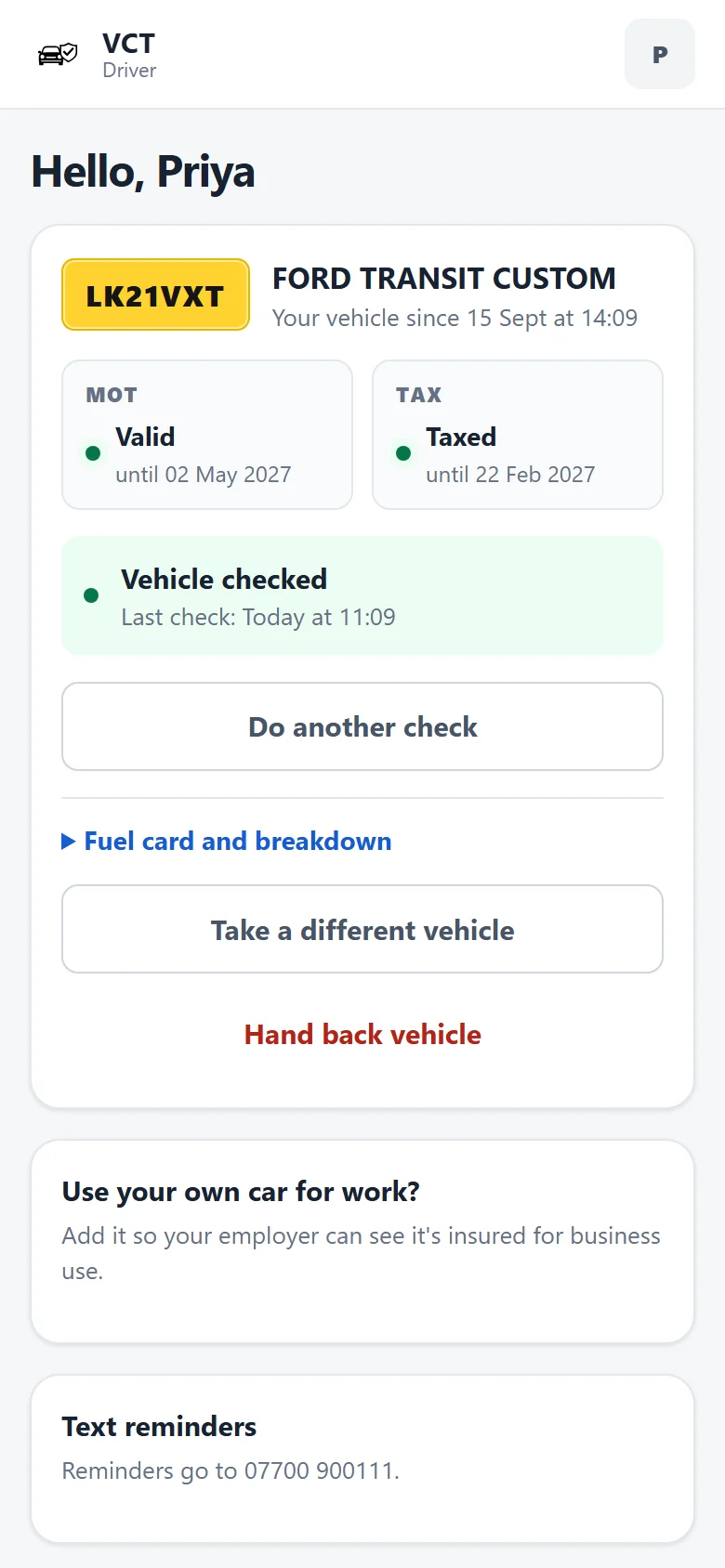
Crews often start early and drive a long way before the first job. In VCT the driver opens their phone's browser, sees today's vehicle and taps each item green, amber or red.
DVSA's guidance on van daily walkaround checks includes the load and any tail lift, and there is separate guidance for HGV daily walkaround checks. The checklist in VCT is yours to edit, so you can add tail lift, ramp and load strap items. More on the walkaround check app page.
- Nothing to install from an app store, and no paper sheets
- Amber and red items reach the office straight away with the driver's note
- Drivers can take a different vehicle or hand one back from their phone
Where removals fleets get caught out
Removals work is booked in advance, shared between crews and often a long way from base. That is where things slip.
Moving day can't wait
A completion date won't move because an MOT ran out. VCT shows anything due in the next 30 days as Due soon, with reminder emails and a weekly round-up, so you can book the test around the diary.
Crews sharing vehicles
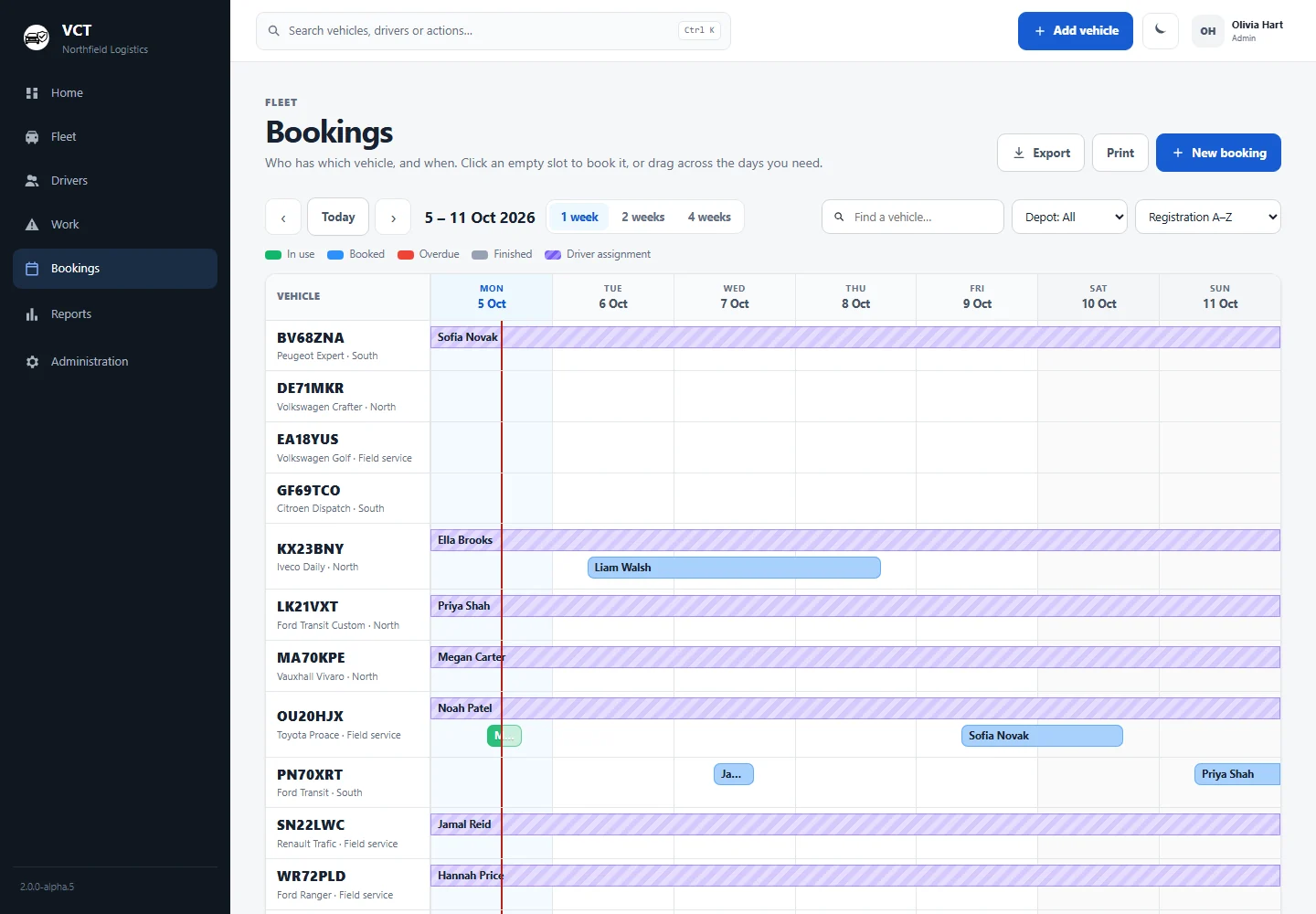
The Luton van one crew used on Monday goes out with another on Tuesday. Each driver does their own check, and the bookings timeline shows who had which vehicle and when.
Long-distance moves
A fault found 200 miles from the depot needs to reach the office fast. The driver marks it red or amber with a note, and it goes straight into the work queue.
Vans and lorries on different clocks
A van's first MOT is at three years. A new lorry's first annual test is due 12 months after registration. VCT takes each expiry date from DVSA, so you don't have to track which rule applies.
Know which vehicle each crew has for each move
The bookings timeline shows who has which vehicle and when. Book a lorry to a driver for the days of a move, and VCT catches the clash if someone else already has it.
- Long-term assignments for vehicles that stay with one driver
- Export to a spreadsheet or calendar file
Every defect tracked until it's fixed
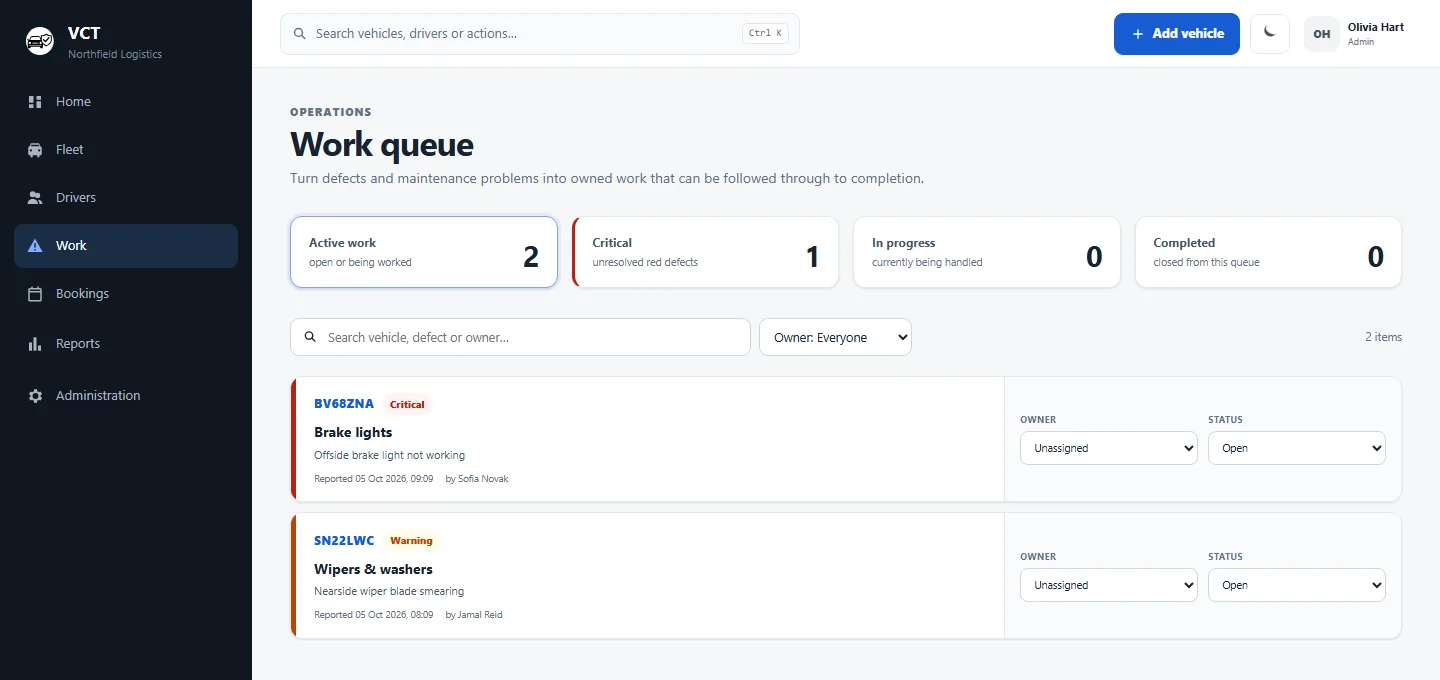
A tail lift fault reported on Tuesday shouldn't be a surprise on Friday's move. Every red or amber item becomes work in the queue, with critical items at the top. Give it an owner and track it to done. The defect only clears when a later check marks the same item green.
HSE's guidance on making sure drivers are safe says induction should cover daily vehicle safety checks, and that these are especially important for drivers who travel long distances.
- See which drivers are checking and which aren't, over the last 30 days
- Service records and costs on each vehicle
7.5 tonne and larger lorries
VCT reads lorry annual test results from DVSA the same way as van MOTs, and checks road tax with DVLA. GOV.UK says petrol and diesel goods vehicles over 3,500kg need an annual test, first due 12 months after the vehicle was first registered. The HGV Road User Levy applies to lorries of 12,000kg or more and is paid with road tax, so a lorry shown as taxed has its levy covered. More on HGV fleet compliance.
GOV.UK explains that if your business uses goods vehicles with a gross plated weight over 3,500kg, you usually need a goods vehicle operator's licence. Some vehicles are exempt. The same page says your drivers must have the correct licence and training.
Under GOV.UK's driving licence categories, a car licence passed on or after 1 January 1997 covers petrol and diesel vehicles up to 3,500kg maximum authorised mass, and category C1 covers vehicles between 3,500kg and 7,500kg. DVLA's check driving information service shows what someone can drive. Record the check and the driver's consent in VCT.
From the yard to the record
- Import your vehicles. Upload your vans and lorries as a CSV and preview every change before it's saved.
- VCT checks overnight. Road tax with DVLA and the MOT or annual test with DVSA, with reminder emails before anything runs out.
- Book vehicles to crews. The bookings timeline shows who has which vehicle each day.
- Drivers check on their phones. Before setting off. Amber and red items go to the work queue.
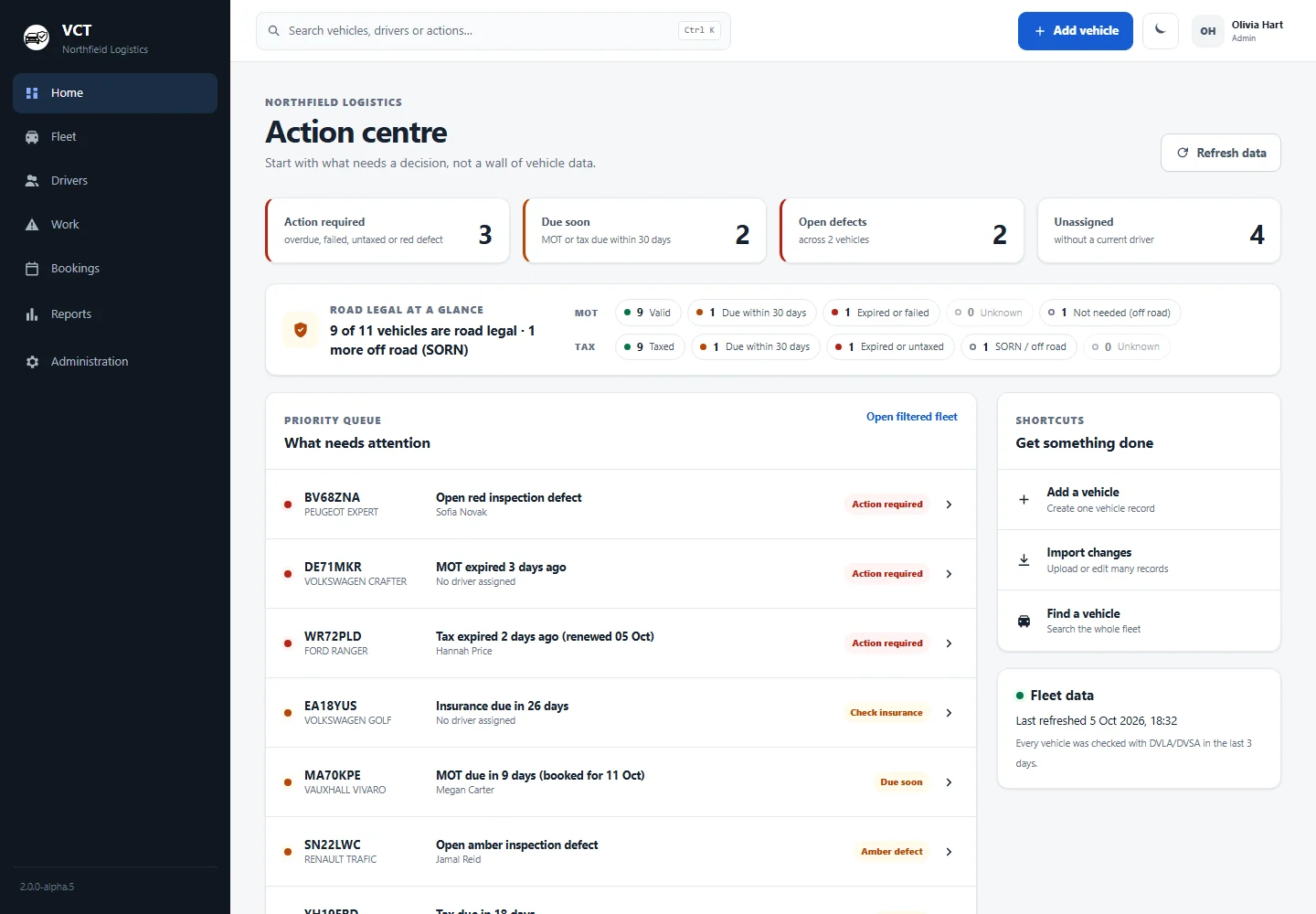
- You see what needs action. The Action centre shows how many vehicles are road legal and what to do first.
Records ready for an insurer, an audit or a customer
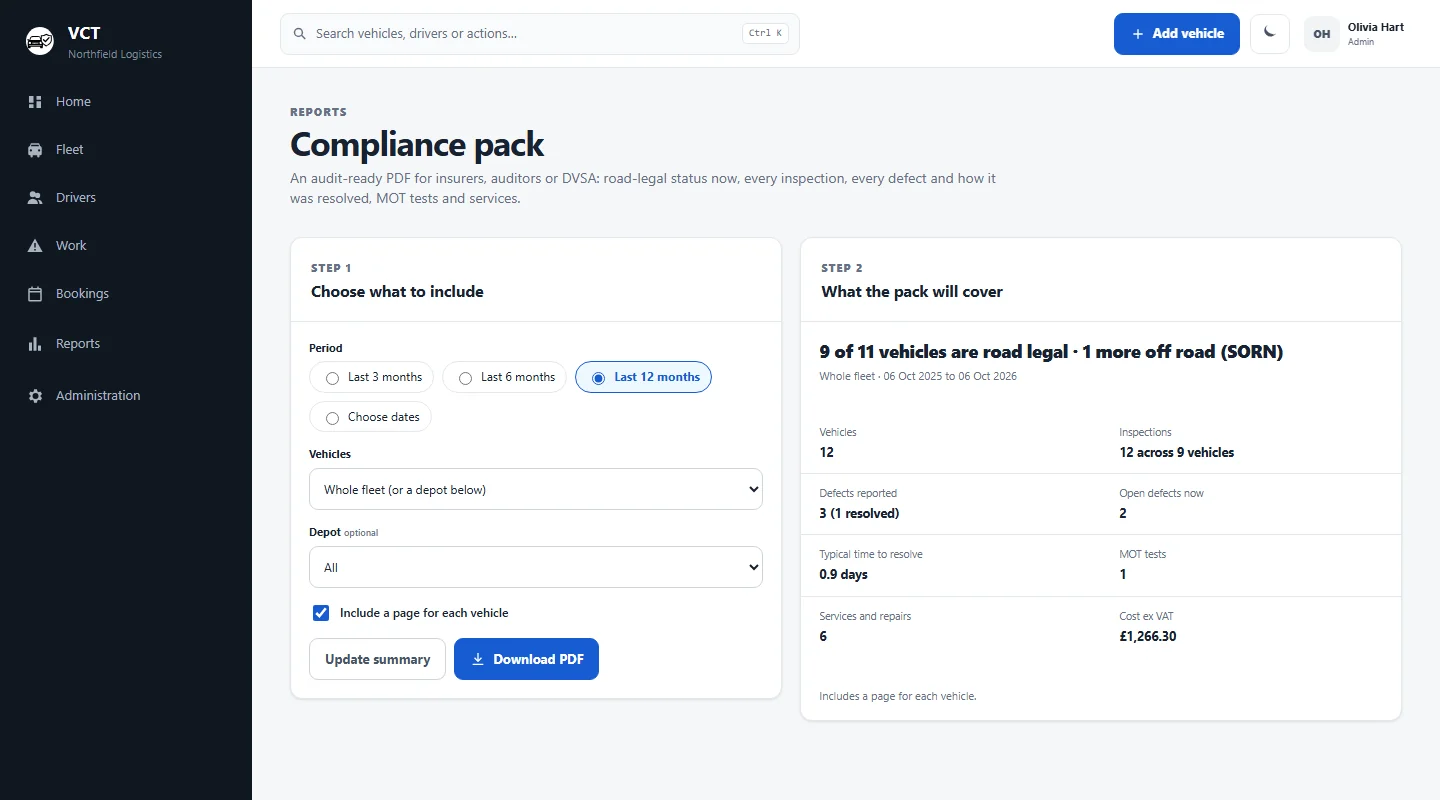
Insurers, auditors and commercial customers may ask how you check vehicles and how quickly you fix defects. The compliance pack is a PDF for a period and depot you choose, covering road-legal status, every inspection, every defect and how fast it was fixed, MOT and annual tests, services and costs. Use it for an insurer's renewal, an O-licence audit or a DVSA visit.
- A weekly round-up email to admins and managers on the day you choose
- Export everything at any time
VCT covers vehicles only, so it won't track storage units or containers. Still on a spreadsheet? See VCT vs spreadsheets.
What it costs for a removals fleet
£3.50 per vehicle a month, falling to £2.50 per vehicle for bigger fleets (minimum £35 a month), ex VAT. Every vehicle costs the rate for your fleet's size band, with everything included. A lorry costs the same as a van. You pay monthly, with no contract.
For example, a small firm with 4 Luton vans and 2 lorries pays the minimum of £35 a month, which is the price for 10 vehicles. A firm with 14 Luton vans and 6 lorries has 20 vehicles: 20 × £3.50 = £70 a month. A larger firm with 35 vans and 20 lorries has 55 vehicles: 55 × £3.00 = £165 a month. Over 200 vehicles, get in touch.
Texts are the only add-on, at £10 a month for up to 200 texts. If prices go up, existing customers keep the price they signed up at. See full pricing.
Removals fleet software FAQs
Does a lorry cost more than a Luton van?
No. Every vehicle costs the rate for your fleet's size band, whether it's a van, a lorry or a car. Annual test and road tax checks are included for lorries.
Can we add tail lift checks to the walkaround?
Yes. The checklist is yours to edit, so you can add items such as the tail lift, ramp and load straps, and HGV items for your lorries.
Can VCT check our trailers?
Not automatically. Trailers don't have a registration number, so VCT has nothing to look up with DVSA. Vans, lorries and cars are checked every night.
Does VCT track drivers' hours or tachographs?
No. VCT doesn't analyse tachograph data or track drivers' hours, and it doesn't manage operator licences or schedule safety inspections. It keeps walkaround checks, defects, MOT and annual test results in one place.
Is there a free trial?
There is no free trial. Enter a registration and your email on the homepage instead, and we'll email you a link to a demo with your own vehicle looked up live.
More in our HGV walkaround check guide, our van walkaround checklist and on the MOT and tax reminders page.
See it with one of your own vehicles
Enter a registration and your email on the homepage. We'll send you a link to a demo of VCT with your vehicle looked up live with DVLA and DVSA.